How Al-Qaeda Funded Oyo School Kidnappings to Force Release of Ansaru Terror Leaders

ABUJA, Nigeria — Nigerian authorities have revealed that international terrorist network Al-Qaeda sponsored the May 15 school attacks in Oriire, Oyo State.
The attack was said to be a desperate bid to force the Federal Government to release high-profile terrorist leaders.
This was disclosed before a Federal High Court in Abuja on Monday in the ongoing trial of five Asaru terror suspects arrested in connection to the deadly school kidnapping where a teacher was brutally beheaded.
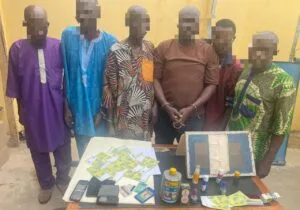
The suspects are Mahmud Muhammad (also known as Abu Bara’a or Abbas Mukhtar), Abubakar Abbas (also known as Isah Adam or Mallam Mahmuda Al-Nigeri), Abdulrazak Umar (also known as Abu Khalifa/Abu Khalid), Yunusa Musa (also known as Abu Yunusa Bin Musa), and Shamsu Adamu Sani (also known as Abu Itisar).
Testifying behind a protective shield, a key prosecution witness identified only as ‘BBB’ revealed that the proscribed terrorist group Jama’atu Ansarul Muslimina fi-Biladis Sudan (Ansaru) executed the coordinated school kidnappings under the active financial and logistical backing of Al-Qaeda.
The court heard that following the abduction of students and teachers during the Oriire raids, the terrorists issued an ultimatum to the Federal Government, submitting a list of 30 detained Ansaru leaders and members who demanded immediate release.
The witness stated that the terrorists threatened to execute all hostages if their demands were not met, prompting security agencies to launch a successful rescue operation after the government firmly refused to negotiate.
“They made a demand and submitted a list of 30 members, including their leaders to the government, warning that if their demands were not met, they would kill the victims,” he told the court. “They were very hostile. The security agencies later launched an offensive at the forest. They shot at the security operatives and slaughtered one of the victims and threatened to kill others if there were efforts to rescue the victims,” he added.
According to federal prosecutors, the defendants hail from Okene Local Government Area (LGA) in Kogi State, Daura LGA in Katsina State, and Suleja LGA in Niger State.
Led in evidence by the Director of Public Prosecution of the Federation (DPPF), Oyedepo Rotimi (SAN), the witness provided deep insights into the architecture of the terror cell. BBB testified that the first defendant, Mahmud Muhammad, was a notorious founding member of Boko Haram and formerly served as the group’s Head of Security and Intelligence in Maiduguri.
Muhammad broke away from Boko Haram in 2012 alongside others to establish Ansaru, aiming to enforce Islamic governance and target foreign nationals. The witness recalled that Ansaru’s brutal execution of seven foreigners in 2014 prompted the United States government to designate the group a proscribed terrorist organisation and declare Muhammad a globally wanted terrorist.
Following Muhammad’s eventual arrest by security forces in 2025, the group activated a hardline operational doctrine: orchestrating mass casualty events and high-profile kidnappings to leverage the release of their captured leaders.
The witness further alleged that after Muhammad took control of Ansaru, he appointed the second defendant, Abubakar Abbas, as the cell’s Head of Operations. Abbas reportedly spearheaded a series of violent campaigns across the country, including a deadly ambush on the convoy of the Emir of Potiskum and a separate raid that claimed the lives of 17 military officers and three civilians.
“They (the terrorists) submitted a list, including the names of the first and second defendants, who they wanted the government to release, or else they will kill all the victims.
“Security agencies were able to secure the release of the victims. But unfortunately, we lost security personnel, including a senior police officer and an Army officer. Two of the victims were also murdered prior to the rescue operation,” said the witness.
The trial continues on Tuesday, October 13, 2026, as the court evaluates further evidence regarding the group’s cross-regional terror network.